Formosan termites (*Coptotermes formosanus*) and native eastern subterranean termites (*Reticulitermes flavipes*) inflict catastrophic damage across Houston structures due to hyper-saline coastal air, persistent 80%…
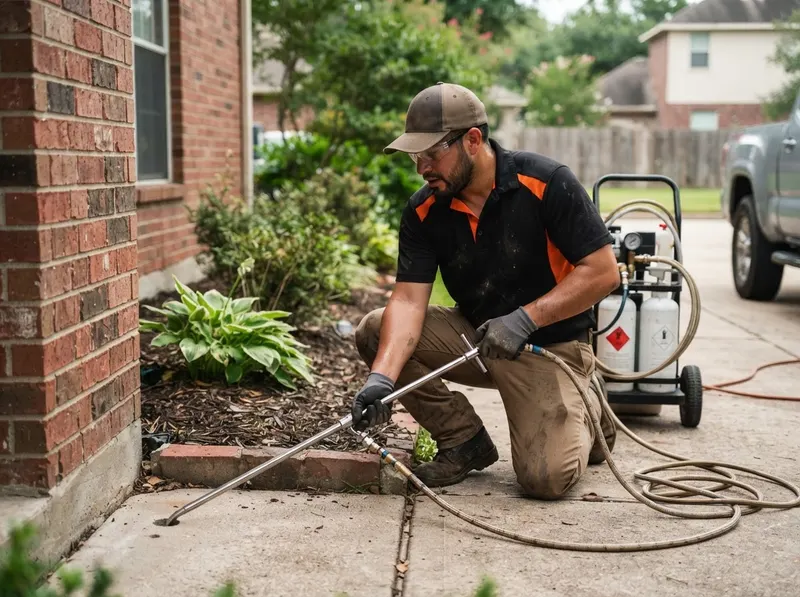
Formosan termites (*Coptotermes formosanus*) and native eastern subterranean termites (*Reticulitermes flavipes*) inflict catastrophic damage across Houston structures due to hyper-saline coastal air, persistent 80% summer humidity, and wet gumbo soils that support massive subterranean biomass. Native subterranean colonies dwell entirely beneath grade and enter via concrete expansion joints, plumbing penetrations, or brick weep holes. Formosan colonies present a distinct, aggressive mechanical threat: an established mature colony contains up to ten million individuals that forage through three-hundred-foot underground radii and construct moisture-retaining secondary nests (cartons) inside wall voids without requiring ground reconnection. In older pier-and-beam bungalows throughout The Heights and Montrose, floor joist moisture creates prime conditions for rapid subfloor honeycombing, while post-tension concrete slabs in newer builds across Spring Branch and Kingwood remain susceptible to ingress via cold joints and untreated plumbing sleeves.
Eradication protocols require precise liquid barrier mechanics rather than surface repellent sprays. Field technicians excavate continuous trenches six inches wide by six inches deep directly adjacent to foundation walls, flooding the soil with non-repellent termiticides like fipronil at the verified Texas Department of Agriculture label rate of four gallons per ten linear vertical feet. When foraging insects cross an undetectable transfer barrier, they physically pass the active ingredient to nest mates via mutual grooming and trophallaxis, collapsing the central brood chamber within thirty to sixty days. For properties containing brick veneers over framing, concrete foundation footing slabs must be drilled horizontally or vertically every twelve inches using carbide-tipped bits to deliver chemical zones directly beneath the concrete slab interface where termites penetrate unseen.
Aerial Formosan carton infestations, commonly discovered within the flat roof systems of River Oaks estates, multi-story attics in Memorial, or moisture-retaining framing near Galveston Bay winds in Clear Lake, demand supplemental direct localized protocols. Ground trenching alone fails to arrest an active aerial nest that draws moisture from flat roof pooling or leaky air conditioner condensate lines. Technicians use thermal imaging scanners and non-invasive acoustic moisture meters to delineate carton boundaries inside walls, followed by drilling small observation ports to inject dry nitrogen-propelled expanding fipronil foam directly into structural timbers. In flood-prone regions such as Meyerland and West University Place, high water tables frequently degrade past chemical treatments, necessitating specialized hexaflumuron or noviflumuron baiting arrays spaced ten to twenty feet along the property perimeter to achieve long-term colony elimination without chemical dilution.
Structural protection balances initial installation labor against long-term chemical durability. Liquid perimeter barriers provide an unbroken non-repellent exclusion band with a five to eight-year ground half-life in non-flooded soils, but require trenching garden beds and drilling through decorative patios or driveways. In contrast, station-based monitoring systems preserve exterior masonry and finished walkways around Garden Oaks homes, yet rely on insect foraging speed and require biannual bait cartridge replacements to maintain population suppression. The trade-off centers on site architecture: unencumbered dirt perimeters favor continuous trenching, while expansive wrapping hardscapes and low-lying drainage channels dictate localized injection paired with exterior structural baiting matrices.
Every job gets a firm, written price after a free on-site visit.
Tell us about your subterranean and formosan termite extermination job in Houston and we'll send a clear, written quote, usually the same day.
 Silver Wagon Pest Control